(618)234-3630
905 West Blvd. Belleville, IL 62221

Motor graders play a critical role in road construction, site preparation, mining operations, and land development projects. Whether you’re maintaining gravel roads, building highways, or preparing job sites, the performance of your grader depends heavily on one key component: the tires.
Choosing the right grader tires can improve traction, increase productivity, reduce operating costs, and extend tire life. With multiple tire sizes, tread patterns, and construction types available, understanding what to look for can help you make the best investment for your equipment.
Grader tires are designed to provide stability, traction, and durability while supporting the unique demands of grading operations. Unlike other heavy equipment tires, grader tires must perform well while maintaining precise control during leveling, shaping, and finishing work.
The wrong tire can lead to:
Selecting the proper tire helps maximize both efficiency and profitability.
One of the first factors to consider is where your grader spends most of its time working.
For highway and road construction projects, operators often need tires that provide excellent stability, long wear life, and smooth operation on compacted surfaces.
Maintaining gravel roads requires tires capable of handling loose material while resisting cuts and abrasions.
Harsh conditions found in quarries and mines demand heavy-duty grader tires designed for exceptional durability and resistance to damage.
If your grader works in multiple environments, selecting a versatile tread design may provide the best balance between traction and wear life.
Tread design directly impacts performance and tire longevity.
Aggressive tread patterns provide better grip in loose soil, mud, and uneven terrain.
These tread styles often perform well on hard-packed surfaces and paved roads where stability and wear resistance are priorities.
Many contractors prefer versatile tread designs that deliver reliable performance across a variety of conditions.
Choosing a tread pattern that matches your typical workload can significantly improve tire performance.
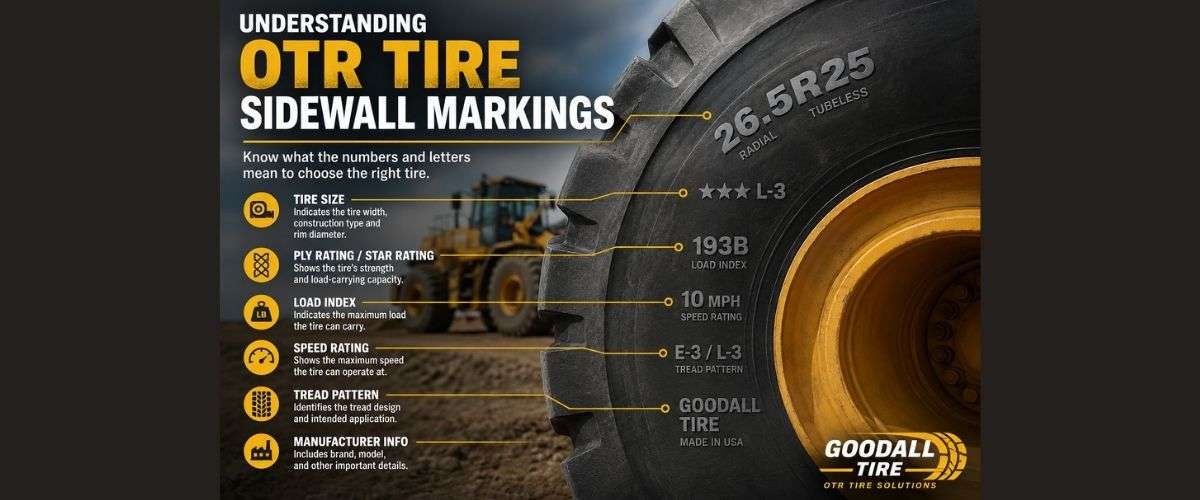
Using the correct grader tire size is essential for safety and performance.
The recommended tire size can usually be found:
Installing the wrong size may affect machine handling, load capacity, and grading accuracy.
If you’re unsure which size is appropriate, a qualified tire supplier can help identify the correct fitment for your specific grader model.
Grader tires are commonly available in both radial and bias constructions.
Radial tires typically offer:
Bias tires often provide:
The best choice depends on your operating conditions, budget, and equipment usage.
Many contractors choose used grader tires to reduce operating costs.
When purchasing used grader tires, inspect:
Quality used grader tires can provide excellent value when sourced from a reputable supplier.
While cost is always important, the cheapest tire is not always the most economical option.
A tire that lasts longer, improves traction, and reduces downtime may ultimately save significantly more money over its service life.
When evaluating grader tires, consider:
Choosing grader tires involves more than simply matching a size. Tire experts can help evaluate your application, operating environment, and budget to identify the best solution for your equipment.
An experienced supplier can also help you compare new grader tires and quality used grader tires to determine which option delivers the best return on investment.
At Goodall Tire, we help contractors, municipalities, construction companies, and heavy equipment operators find dependable grader tires for a wide range of applications. Whether you’re looking for new grader tires, used grader tires, or hard-to-find tire sizes, our team can help you find the right solution for your equipment and budget.
Contact Goodall Tire today to learn more about our available grader tire inventory and expert tire recommendations.